Proof-of-Authority • ECDSA DECENTRALIZED DNS REGISTRY

Turning DNS into a Transparent, Verifiable Blockchain Ledger

HyperDNS is a teaching-grade decentralized DNS system where every domain registration, IP update, and ownership transfer is stored on a Proof-of-Authority blockchain. Instead of trusting a central DNS provider, clients verify state from a network of validator nodes.

0 SPOF No Single Point of Failure
100% History Preserved
On-Chain Domain Ownership
PoA Efficient Consensus

Concept What is HyperDNS?

HyperDNS is a blockchain-based Domain Name System. In normal DNS, a small set of companies and registries control who owns which domain and where it points. In HyperDNS, this information is stored as transactions and blocks on a blockchain, making the registry transparent, auditable, and tamper-resistant.

The project includes:

Backend

A Flask-based API that implements the HyperDNS blockchain, transaction mempool, domain registry, resolver, and Proof-of-Authority (PoA) consensus. Each node keeps its own copy of the chain and exposes HTTP endpoints for domain operations and chain inspection.

Python / Flask Custom Blockchain PoA Consensus

Frontend Dashboard

A modern Neon+Glass UI where users can connect a local wallet, register domains, update records, transfer ownership, visualize the P2P network, and inspect blocks. This frontend talks directly to the Flask nodes through REST APIs.

HTML / CSS / JS MetaMask-style Wallet UX Network & Block Explorer
Blockchain DNS Visualization

In HyperDNS, the domain registry behaves like a financial ledger: each update is a signed event, not a hidden configuration change.
Motivation What is wrong with traditional DNS?

The current DNS system works well, but it is centralized and opaque. In practice, a small number of providers and registries can:

Common weaknesses of legacy DNS
  • Single registries can suspend or seize a domain if pressured or compromised.
  • Large DNS providers are attractive targets for DDoS attacks, causing widespread outages.
  • DNS cache poisoning and BGP hijacking can silently redirect users to fake websites.
  • Domain history is not transparent. It is hard to prove who changed what and when.
  • End users must trust that every DNS response they see is honest and unmodified.
How HyperDNS addresses these issues
  • Ownership is tied to cryptographic keys, not to a registrar account.
  • Every change is a signed transaction recorded in an immutable block.
  • Multiple validator nodes share the registry; there is no single master server.
  • Full history is on-chain, so disputes can be resolved by reading the ledger.
  • Resolvers can verify responses against the chain instead of simply trusting one server.

In real-world terms, HyperDNS is a step towards a DNS where rules are enforced by cryptography and code, not by manual policies or tickets in a support system.

Value Why does a decentralized DNS matter in the real world?

HyperDNS is a learning-oriented prototype, but it models real concerns that companies, governments, and users face today.

Security & Integrity

A blockchain registry makes unauthorized changes extremely difficult. Any domain change requires a transaction signed with the owner's private key. Attackers cannot simply compromise a control panel or trick a support team into moving a domain.

Auditability & Compliance

Because all operations are logged in blocks, internal audits become easier. Security teams can see exactly when a record was updated, who signed it, and what changed. This is useful for regulated environments and incident investigations.

Censorship Resistance

In certain countries or situations, domains are blocked or taken down for non-technical reasons. A decentralized registry makes it much harder for a single party to silently remove a name. Any attempt to censor would have to fight against the whole validator network.

Multi-Organization Collaboration

Large organizations with many teams or international branches can share the same HyperDNS chain. Each department can operate its own node and still trust that they are reading the same global state without depending on one central admin.

Real-World Scenarios

1
Protecting critical domains from hijacking
Banking, government, or university portals
For critical services, a DNS compromise can be worse than an application bug. HyperDNS forces all changes to go through signed blockchain transactions, reducing the risk of a silent takeover via social engineering or panel misconfiguration.
2
Internal naming inside an organization
Microservices in a data center or campus network
Instead of manually maintaining spreadsheets or local DNS zones, teams can use HyperDNS as an internal registry where every microservice name is recorded on-chain. Any engineer can see who owns which service and how it evolved.
3
Research and education
University labs or blockchain courses
HyperDNS is deliberately designed as a complete, understandable project. It is suitable for demonstrating blockchain concepts (blocks, signatures, consensus, state) using a problem that everyone understands: domain names.

Design System Architecture

HyperDNS combines a lightweight blockchain, validator nodes, and domain registry modules into one coherent system. Below is a concise, implementation-oriented view.

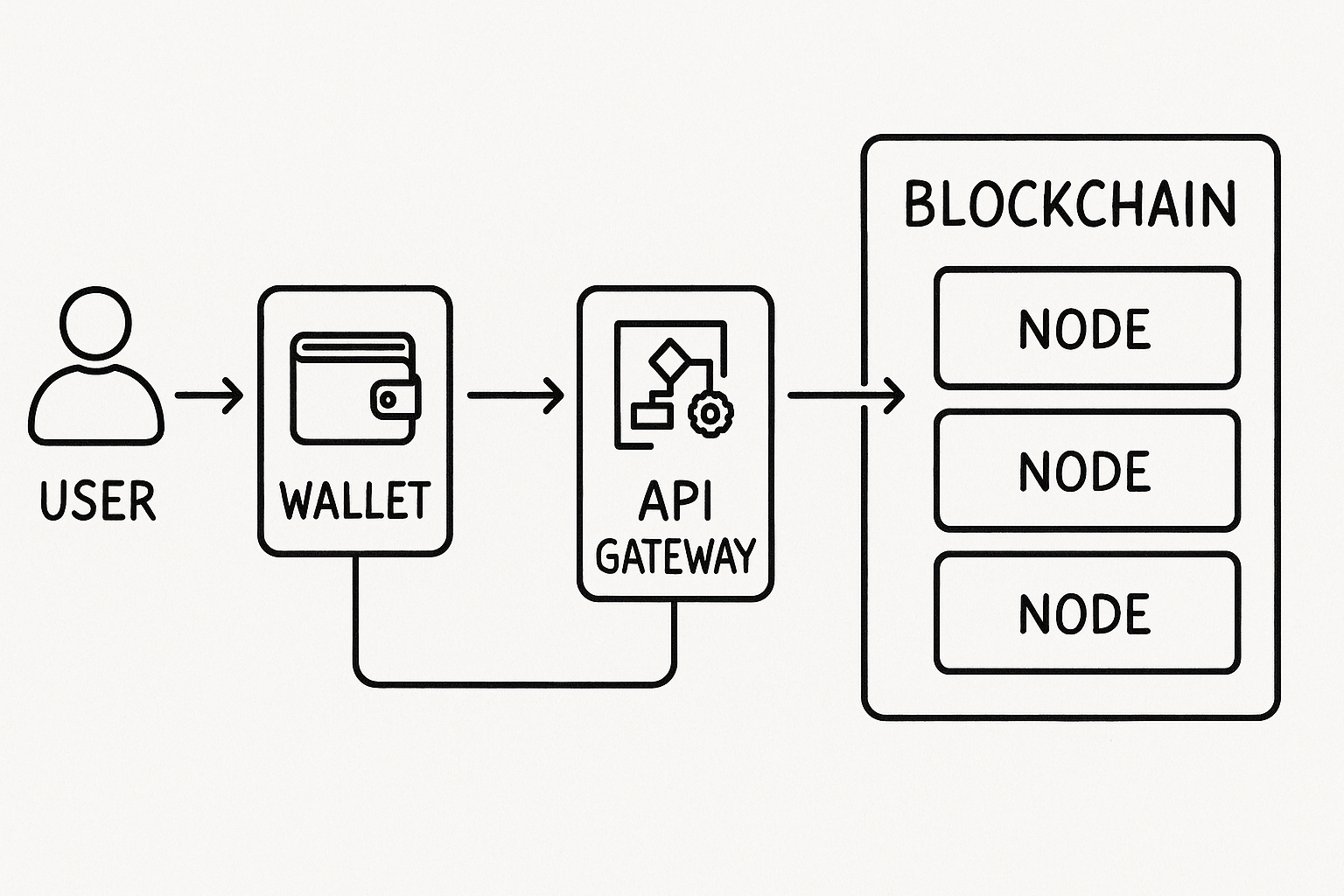
HyperDNS Architecture Diagram
Wallets sign domain transactions → Validators bundle them into blocks → Nodes maintain the same blockchain state → Resolver looks up the latest record.

How a single domain update flows through the system

1
User opens the HyperDNS dashboard, connects a wallet, and fills out a form to register or update a domain.
2
The frontend creates a transaction object and asks the wallet to "sign" it, simulating MetaMask-style signing.
3
The signed transaction is sent to a node's /register or /set_record endpoint. The node verifies the signature and business rules, then adds it to the mempool.
4
A validator node calls /create_block. The node builds a block from mempool transactions, signs the block, validates it, and appends it to its chain file.
5
The node rebuilds the state, so the new domain record becomes "live". Any client calling /resolve/domain.dns now receives the updated IP and owner information.

Capabilities Core Features

Blockchain-Backed DNS

Domain ownership and records are not just configuration files; they are on-chain entries with global history.

Wallet & Signature Flow

Users "connect" a wallet and sign actions in a MetaMask-inspired workflow, reinforcing the idea that ownership is key-based.

Multi-Node P2P View

The frontend visualizes nodes as a mesh network, reflecting how multiple servers can host the same registry.

PoA Block Production

Blocks are produced by authorized validators. This is simpler than Proof-of-Work and suitable for private networks.

Versioned Domain State

Each change increases the version of the domain, so rollbacks and history inspection are straightforward.

Explorer & Admin Tools

Built-in tools show blocks, mempool contents, validator info, and per-domain history in a readable form.

Application Where could systems like HyperDNS be used?

Even though HyperDNS is a prototype, similar ideas can appear in production systems. Here are some realistic directions.

Enterprise Internal DNS

Large companies can run a private HyperDNS network to manage internal service names. Each team gets its own keys and can manage its domains without waiting for a central admin, while the security team still has a full audit log.

Web3 & DApp Naming

Decentralized applications can benefit from DNS-like systems where names are directly linked to wallets or smart contracts. HyperDNS shows how such a registry could be implemented without relying on ICANN.

University and Research Labs

Universities can use HyperDNS in teaching laboratories to demonstrate consensus, attacks on DNS, and how decentralization changes trust assumptions. Students can see the full code and experiment freely.

Human-Readable Wallet Names

Instead of using raw public key hashes, users can map wallets to readable domains such as alice.dns. This is similar to ENS, but with a focus on simple PoA consensus and a custom implementation.

From concept to running software in one project

HyperDNS is not just a diagram. It is a working prototype that includes a blockchain engine, a DNS-style registry, a resolver, a validator dashboard, and a modern web interface. It is designed so that a professor, teammate, or reviewer can read the documentation, run the code, and see every layer working together.